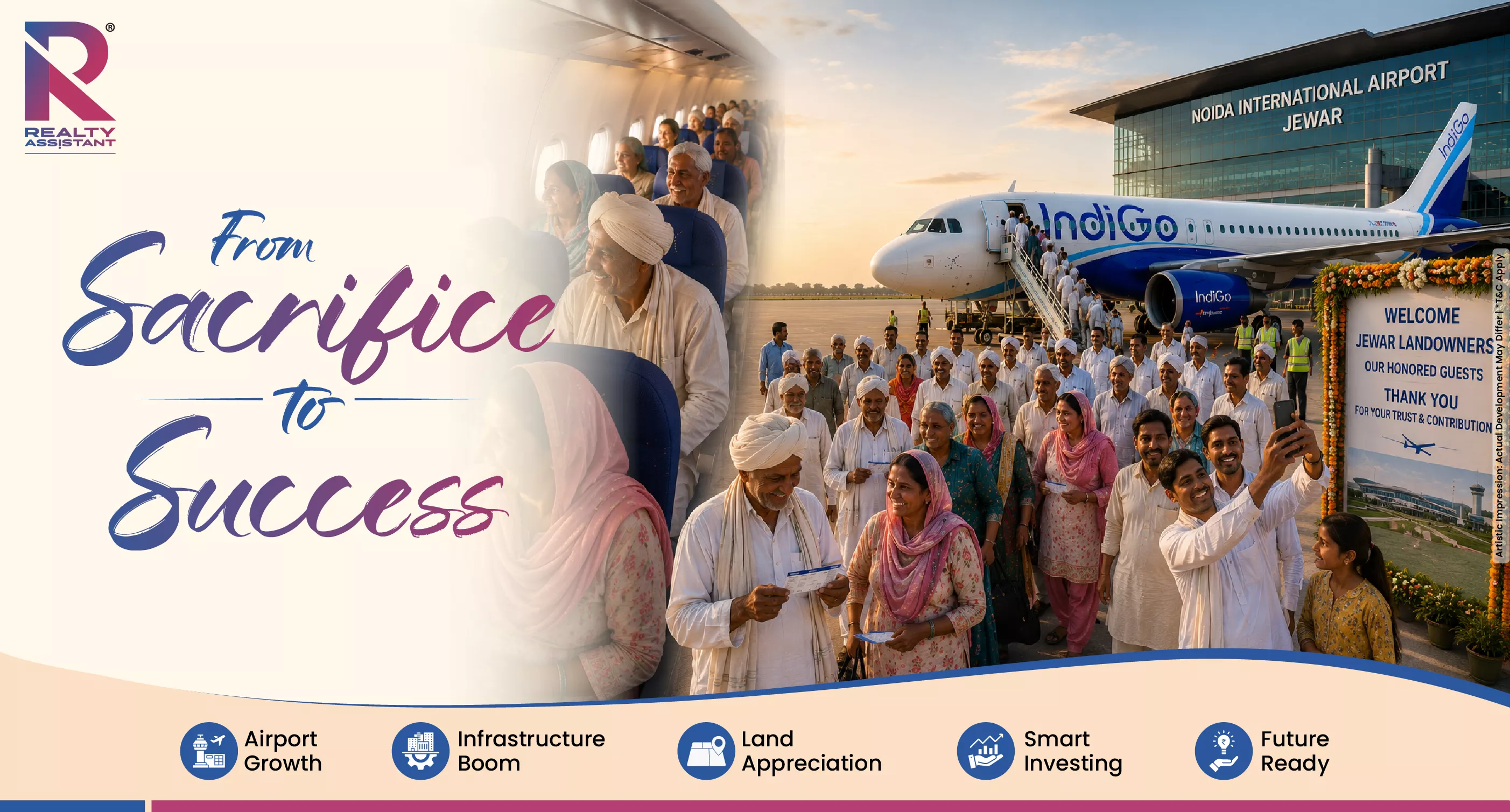
On the morning of June 15, 2026, roughly 170 farmers from the Jewar region walked into a gleaming new terminal, boarding passes in hand.
These were the same people whose ancestral crop fields had been acquired to build Noida International Airport.
Now, they were its first passengers.
Many had never flown before.
Some were women who had quietly watched their fields turn into runways over several years.
That morning, they didn't just fly.
They witnessed the full arc of a transformation they had started.
Summary
The first flight from Noida International Airport carrying Jewar landowners symbolized inclusive development, honoring those who made the project possible.
Beyond its emotional significance, the airport is transforming the Yamuna Expressway region through better connectivity, employment, industrial growth, and rising real estate demand.
For long-term investors, it reinforces how patient investment in infrastructure-led corridors creates lasting value.
Introduction
There is a certain poetry in what happened at Noida International Airport.
The first commercial flight from the Jewar-based facility didn't carry VIP guests or corporate delegations.
It carried farmers.
Villagers from the Jewar region of Gautam Buddh Nagar whose land was acquired for the airport's first phase boarded an IndiGo aircraft to Lucknow.
And were received by Chief Minister Yogi Adityanath on arrival.
Union Civil Aviation Minister Kinjarapu Ram Mohan Naidu personally distributed commemorative boarding passes to passengers during the event.
Jewar MLA Dhirendra Singh described the moment simply and powerfully:
"The very families who dedicated their ancestral land for the national interest and the state's bright future are today taking to the skies from that same soil. Hands that once tilled the land now hold boarding passes."
It was more than a symbolic gesture.
It was a condensed lesson in what infrastructure-led development looks like.
And why patient investors in land have historically been among the greatest beneficiaries of these long cycles.
Why the Jewar Airport First Flight Is Historically Significant
The Jewar Airport first flight is not just a headline. It is a timestamp in a story that began years ago.
When the foundation stone for Noida International Airport was laid in November 2021, it was already envisioned as one of the largest aviation hubs in Asia.
Phase 1, spread across approximately 1,334 hectares and developed by Yamuna International Airport Private Limited.
A fully owned subsidiary of Zurich Airport International AG,
Designed to handle up to 12 million passengers annually.
The full four-phase project targets 70 million passengers and six runways at completion.
What the Jewar Airport first flight represents is the transition from ambition to reality.
Commercial operations formally began on June 15, 2026, after the airport received its aerodrome license from the Directorate General of Civil Aviation in March 2026 and was inaugurated by Prime Minister Narendra Modi earlier that year.
Between the first stone and the first flight, an entire corridor changed.
People-Centric Development: More Than a PR Moment
Development stories in India often focus on steel, concrete, and investment figures.
The decision to give the inaugural commercial flight to the families who sacrificed their land shifts that narrative meaningfully.
Abrar Khan, one of the farmers who boarded the flight, said:
"We are very delighted and obliged to travel on the first flight."
That sentiment carries weight beyond personal pride.
It reflects a model of development where communities that enable infrastructure projects become visible participants in its celebration.
When government and institutions acknowledge land contributors this directly, it builds trust in future land acquisition processes and signals a maturing approach to inclusive growth in Uttar Pradesh.
For real estate and land investors watching from the sidelines, this moment also underscores something important:
Infrastructure transformations in India are no longer driven by the government alone.
Communities, local economies, and surrounding regions all get drawn into the growth story.
That breadth of inclusion tends to create stronger, more durable appreciation cycles.
NIA is reshaping the region by driving connectivity, creating jobs, and unlocking long-term economic growth.
A New Connectivity Spine for North India
Noida International Airport is positioned roughly 72 kilometers from Delhi, directly along the Yamuna Expressway.
Before this airport, travelers from western Uttar Pradesh including districts like Agra, Mathura, Aligarh, Ghaziabad, and Etawah, had limited options beyond the heavily congested Indira Gandhi International Airport.
The new airport changes that fundamentally.
It offers a runway that is CAT-III B compliant, enabling operations in visibility as low as 50 metres, meaning flights can operate even during dense winter fog, historically one of the most disruptive factors for north India's air travel.
IndiGo launched operations first.
Akasa Air announced plans for both domestic and international services.
The connectivity ripple extends across the entire Delhi-NCR ecosystem.
Employment, Industry, and the Aerotropolis Effect
The Uttar Pradesh government has estimated the airport will generate close to one lakh direct and indirect jobs in the years ahead.
The economic perimeter extends well beyond aviation.
Commercial operations have already begun attracting logistics companies, warehousing facilities, and manufacturing units to the region.
The airport is expected to anchor a broader industrial ecosystem - logistical parks, business hubs, retail clusters, and eventually a multi-modal cargo terminal through Air India SATS, which was nearing completion at launch.
This is the aerotropolis model in action: where an airport becomes the nucleus of a self-sustaining economic zone.
Jewar is India's clearest current example of this transformation in progress.
The Yamuna Expressway Industrial Development Authority (YEIDA), which manages development across the 165-kilometre expressway corridor, has an approved Master Plan 2041 targeting a population of 37 lakh within a 769-square-kilometre urbanizable zone, with 6,806 hectares earmarked for residential development and 8,445 hectares for industrial and mixed-use zones.
The Long Game: Why Land Rewards Patient Investors
The biggest gains in land investing often come to those willing to wait through the early stages of growth.
Infrastructure Cycles Don't Move in Months
Here is the investment truth that the Jewar story illustrates with unusual clarity:
Infrastructure-led land appreciation operates in cycles measured in years, not quarters.
From foundation stone to first flight, Noida International Airport took over four years.
During that period, anyone who invested in land along the Yamuna Expressway in 2020 or 2021, before the airport's development became fully visible to the broader market, was building a position that has compounded through every infrastructure announcement, every regulatory clearance, and every kilometer of construction progress.
A Square Yards report noted that residential apartment prices along the Yamuna Expressway corridor nearly tripled between 2020 and 2025, with plot values rising approximately 1.5 times over the same period.
That trajectory is directly linked to infrastructure momentum and is expected to continue as the airport's full operational and commercial ecosystem matures.
The patient investor who understood this cycle early did not need to predict exact appreciation figures.
They needed to understand one thing:
When large-scale infrastructure is being built, the land around it almost always becomes more valuable over time.
The only variable is how much time is required.
The Pattern Repeats Across Markets
This is not unique to Jewar.
The land around Bengaluru's Kempegowda International Airport, Hyderabad's Rajiv Gandhi International Airport, and Pune's Chhatrapati Sambhaji Maharaj International Airport all followed similar trajectories.
Slow early appreciation, followed by significant acceleration once the airport became operational and surrounding infrastructure matured.
In each case, the investors who benefited most were those who entered before the noise, stayed through uncertainty, and exited or held after the transformation became undeniable.
The Yamuna Expressway corridor is at an earlier and therefore more compelling stage of that same journey.
Residential Opportunities for Long-Term Investors
Alongside the infrastructure story, established residential developers have been positioning projects along the Yamuna Expressway to meet the housing demand that airport-led growth invariably generates.
Gaursons India.
A developer with over three decades of presence in the NCR market and the delivered 250-acre township of Gaur Yamuna City in Sector 19 has launched Gaur Chrysalis in Sector 22D, Yamuna Expressway.
The project offers 3 BHK and 4 BHK iconic sky residences in a 12-acre development, positioned near the Noida International Airport corridor and designed for buyers seeking a combination of lifestyle quality and long-term investment value.
Projects like these are notable not just as residential offerings but as indicators of developer confidence in the region's long-term trajectory.
When established groups commit capital to a corridor, it signals conviction that the underlying infrastructure story has legs.
Conclusion: The Rule of Patience Holds
The Jewar Airport first flight was a morning that belonged to the farmers of Jewar.
But the story it tells belongs to every investor who understands that India's infrastructure decade is creating opportunities that only reveal their full value over time.
Development of this scale does not deliver overnight.
But when it does arrive and Noida International Airport's arrival was never genuinely in doubt.
The transformation is comprehensive and enduring.
New jobs, new industries, new connectivity, and new demand for housing all converge simultaneously on the surrounding region.
Patient land investors have understood this logic for decades.
The Yamuna Expressway corridor is simply the latest, and perhaps most well-documented, proof that the rule holds.
If you are considering a long-term position in real estate near Noida International Airport, the window to act before the rising demand pushes prices higher, is narrowing.
The first flight has already departed.
The question for investors is not whether this region will grow.
It is whether they will be part of that growth.