India generates nearly 20 percent of the world's data.
It hosts around 3 percent of global data centre capacity.
That gap is not a statistic. It is an investment opportunity of extraordinary scale, and the states that move fastest to close it are going to define India's digital infrastructure map for the next two decades. On July 9, 2026, Gujarat made its move. And it made it decisively, naming Dholera Special Investment Region as the centrepiece of a policy that no serious investor in AI infrastructure or real estate can afford to ignore.
Summary
Gujarat launched the Viksit Gujarat Data Centre Policy 2026-29 on July 9, 2026, targeting Rs 6 lakh crore in data centre investment and 7.5 GW of capacity. Dholera Special Investment Region is the flagship destination for hyperscale and AI-enabled green data centres under this policy. This guide explains the policy's targets, incentives, and what it means for Dholera investment.
Hon'ble CM Bhupendra Patel unveiled the Viksit Gujarat Data Centre Policy 2026-29
Chief Minister Bhupendra Patel unveiled the Viksit Gujarat Data Centre Policy 2026-29 at Mahatma Mandir in Gandhinagar on July 9, 2026. The room included Deputy Chief Minister Harsh Sanghavi, Science and Technology Minister Arjun Modhwadia, Chief Secretary M.K. Das, and a gathering of senior officials and industry leaders.
The numbers in the policy are ambitious by any measure. The target is nearly Rs 6 lakh crore in investment. The capacity target is 7.5 to 8 GW of AI-ready data centres. The stated ambition is to make Gujarat the best destination in India for data centres, strengthening cloud services, artificial intelligence, e-commerce, digital governance, and smart manufacturing simultaneously.
Here is what makes those numbers even more interesting. Before the policy was formally launched, Gujarat had already received proposals for nearly 10 GW of capacity. That is more than the target itself. Deputy Chief Minister Sanghavi confirmed this at the launch, noting that leading Indian and global companies had come forward seeking nearly double the planned capacity.
Think about what that means practically. The demand already exceeds what the government planned for. The policy is not creating investor interest from scratch. It is providing structure and incentives for investor interest that was already knocking on the door.
Gujarat is the eighth state to introduce a dedicated data centre policy, following Tamil Nadu, Uttar Pradesh, West Bengal, Odisha, Maharashtra, Haryana, and Andhra Pradesh. But the Dholera angle gives it a differentiation that the others simply cannot match.
Why Dholera and Not Ahmedabad, Surat, or Vadodara
This is the question worth spending time on, because the answer explains something fundamental about how large-scale digital infrastructure actually gets built.
AI data centres are not like office parks. They consume enormous amounts of power. They require enormous amounts of land. They need underground utility corridors that can carry power, cooling infrastructure, and fibre at scale. They need roads wide enough for heavy equipment and logistics. And increasingly, they need to be powered by renewable energy because global corporations operating AI workloads have sustainability commitments that make coal-powered facilities simply unacceptable.
Older cities cannot offer this. Not because they lack ambition, but because the infrastructure has already been built around residential and commercial uses that cannot be easily shifted. Retrofitting a dense urban environment for hyperscale data centre operations is extraordinarily expensive and slow.
Dholera was designed from scratch. Wide roads were planned before a single building went up. Underground utility corridors were part of the original blueprint. Large contiguous land parcels are available in organised industrial zones. And the proximity to major solar installations in Gujarat gives Dholera direct access to the renewable energy that AI data centres specifically need.
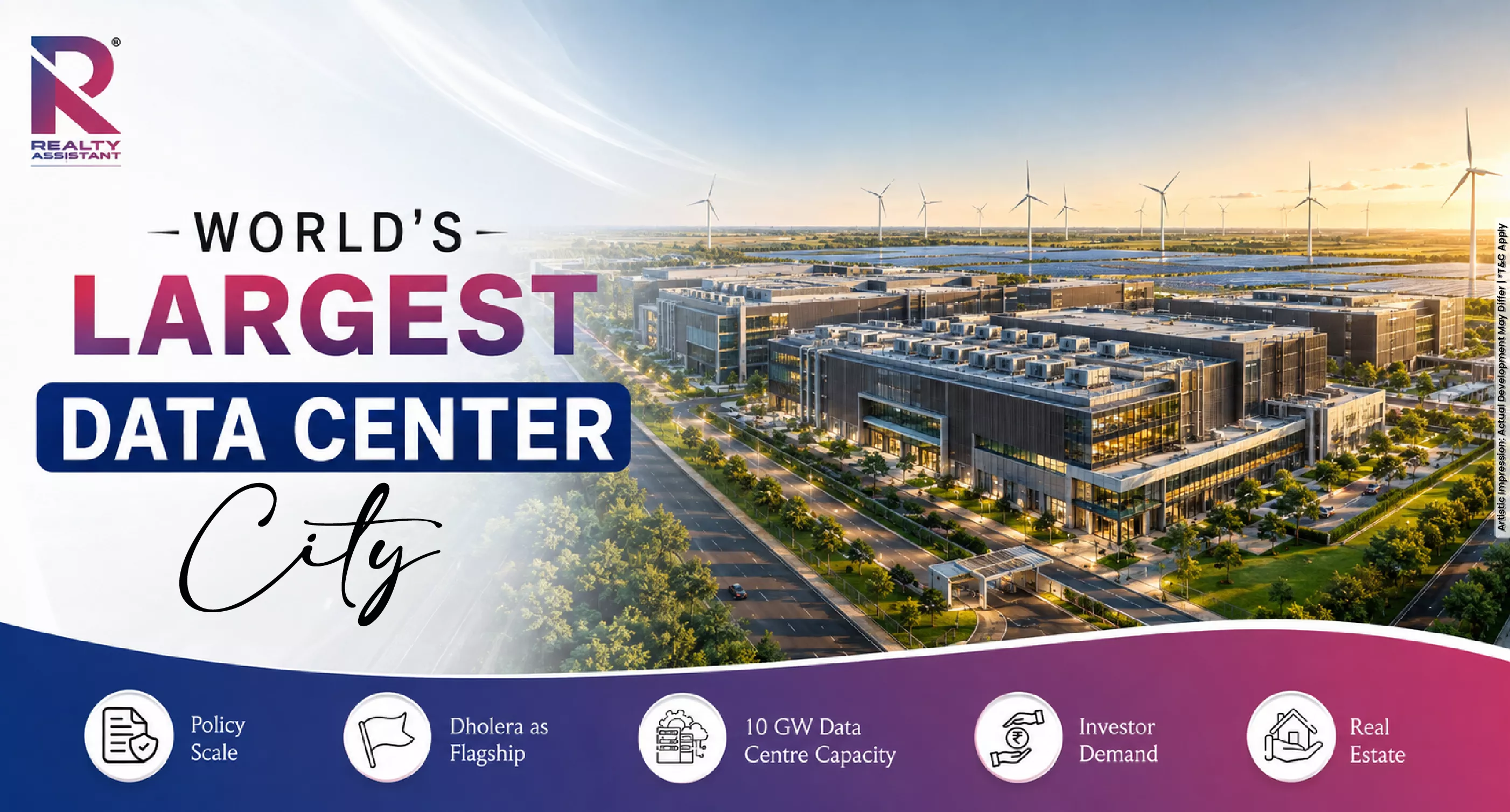
Deputy Chief Minister Sanghavi did not hedge when he described the potential. He said Dholera is moving toward becoming the world's largest data centre city. That is a significant statement from a senior state official. It reflects genuine confidence in what the infrastructure base at Dholera makes possible.
Explore Dholera SIR development to understand the infrastructure foundation that makes this ambition credible.
What the Policy Actually Offers
The fiscal incentive structure in the Gujarat Data Centre Policy 2026 is designed around the specific economics of data centre development, which most other sectors do not share.
Building a data centre requires massive upfront capital. The payback period is long. The ongoing power costs are significant. Any policy that seriously wants to attract this investment needs to address all three of these economic realities, not just the headline subsidy number.
This policy does that.
A capital subsidy of 2.5 percent on eligible fixed capital investment is available, claimable within 10 years. An interest subsidy of up to 4 percent for 10 years, capped at Rs 25 crore annually, reduces the cost of debt financing. Power tariff support and electricity duty reimbursement address ongoing operating costs directly. SGST reimbursement and stamp duty exemptions reduce transaction and operational tax friction. And full reimbursement for eligible infrastructure and services expenses is available for up to 20 years.
That 20-year infrastructure expense reimbursement is the most significant structural feature for long-horizon investors. It covers the full operational maturity phase of a hyperscale data centre, not just the construction period. For global technology companies evaluating India locations for AI infrastructure, that commitment horizon matters because their own investment decisions are made on decade-plus timelines.
What Is Already Being Built at Dholera
The Gujarat Data Centre Policy 2026 did not land on an empty canvas. Significant commitments at Dholera were already in place before the formal policy launch.
In February 2026, the Gujarat government signed an agreement with Larsen and Toubro Vyoma at the India AI Impact Summit in New Delhi. L&T Vyoma committed Rs 25,000 crore to set up a 250 megawatt green data centre at Dholera Special Investment Region, expected to commence operations by 2028. The facility will use clean energy for cloud computing and advanced data analysis operations. The agreement was signed in the presence of state Science and Technology Minister Arjun Modhwadia.
That Rs 25,000 crore commitment from a credible Indian industrial group is not a letter of intent. It is a signed agreement with a defined investment quantum and a 2028 operational timeline.
Earlier, in March 2024, the foundation of a Rs 91,000-crore Tata Electronics semiconductor fabrication plant was laid at Dholera SIR. Semiconductor manufacturing and AI data centre operations are naturally complementary. Both require precision-controlled environments, highly skilled technical workforces, reliable power, and advanced logistics infrastructure. The presence of both at Dholera creates a technology cluster dynamic where each facility makes the next one more attractive to establish.
Six companies have already been allotted land at Dholera. More space remains available for the wave of investors that the new data centre policy is designed to attract.
The Green Energy Advantage Nobody Is Talking About Enough
There is a dimension to the Dholera data centre story that does not get enough attention in the investment conversation.
AI data centres are extraordinarily power-hungry. A single large-scale AI training cluster can consume as much electricity as a small town. Global technology companies, which are the primary tenants of hyperscale data centres, have made public sustainability commitments that require them to power their operations with renewable energy. This is not optional greenwashing. It is a binding operational requirement for companies like Google, Microsoft, and Amazon that have made net-zero commitments to their shareholders.
Gujarat has 69 GW of installed power capacity. Of that, 47 GW comes from renewable energy sources. That is an extraordinary ratio. And Dholera's proximity to the large solar installations in Gujarat's western geography means that renewable power is not just theoretically available. It is practically and economically accessible at the scale that hyperscale AI data centres require.
For global technology companies evaluating where to build AI infrastructure in India, this renewable energy access is not a secondary consideration. It is a deal qualifier. Locations that cannot credibly offer renewable power at scale simply do not make the shortlist for hyperscale AI data centre investment.
Dholera makes that shortlist easily.
What This Means if You Have a Technology Business
If you are evaluating data centre investment in Gujarat for AI, cloud, or hyperscale operations, the practical picture looks like this.
The policy framework is in place with a defined three-year horizon through 2029. The incentive structure addresses the three primary economic challenges of data centre development: upfront capital, debt financing costs, and ongoing operational expenses. The land is available in organised industrial zones at Dholera. The renewable energy is accessible at scale. The physical infrastructure, including wide roads and underground utility corridors, was built into Dholera's original design rather than being retrofitted. And the Dholera International Airport is expected to begin partial operations soon, which matters for the international technology executives and engineering teams who will need to travel to the facility regularly.
The window for establishing a position within the developing Dholera data centre ecosystem is open now, before the 7.5 to 8 GW of planned capacity is fully allocated. Investor demand has already exceeded the target once. The policy provides the structure. The decisions need to be made before the available land allocations are gone.
What This Means if You Are a Real Estate Investor
Every hyperscale data centre requires people to build it, operate it, maintain it, and support it.
The L&T Vyoma 250 MW facility alone will create numerous construction jobs followed by permanent technology and operations roles. The Tata Electronics semiconductor plant adds a further layer of skilled technical employment to Dholera's workforce profile. As more data centre and technology investments arrive under the Gujarat Data Centre Policy 2026, the employment concentration at Dholera SIR grows.
Those employees need to live somewhere.
Dholera is currently only around 5 percent developed out of its planned 920 square kilometre area. The residential supply to accommodate a growing technology workforce is in its early stages. That supply-demand dynamic, where employment is growing and residential supply is still catching up, is exactly the condition that produces residential property appreciation in industrial and technology catchment areas.
Residential investment in Dholera today is made at pricing that reflects the current development stage. It does not yet reflect the Rs 25,000-crore L&T Vyoma facility going operational in 2028. It does not reflect the semiconductor plant workforce. It does not reflect the broader data centre investment wave that the new policy is designed to attract.
Plots for sale in Dholera and residential property near Dholera SIR offer investors the opportunity to position before that employment wave creates the visible residential demand that the broader market eventually reprices to accommodate.
Discover residential investment near Dholera SIR to understand the current options available as this digital infrastructure ecosystem takes shape.
Why Dholera Is Converging on Something Significant
Step back from any single announcement and look at what has happened at Dholera in the past eighteen months.
The Tata Electronics semiconductor plant is under construction. The L&T Vyoma AI data centre agreement is signed. The Gujarat Data Centre Policy 2026 has named Dholera as its flagship hub. The Rs 1 lakh crore HUDCO infrastructure agreement signed in June 2026 includes Dholera Smart City development as a confirmed beneficiary. Adani and Embraer have finalised Dholera for an aircraft final assembly line. The Dholera International Airport is approaching partial operational status.
Each of these is a significant development individually. Together, they describe something more important: a greenfield smart city that is crossing the threshold from ambitious plan to functioning industrial and technology ecosystem.
The investors and businesses who recognise this convergence early, before Dholera becomes the obvious answer that everyone can see, are the ones whose decisions will look most prescient three years from now.
That window is still open. But given the pace of commitments being made at Dholera, it will not stay open indefinitely.