Every month, thousands of business owners pay office rent without giving it much thought.
It's simply considered a business expense.
But at some point, many entrepreneurs start asking a different question:
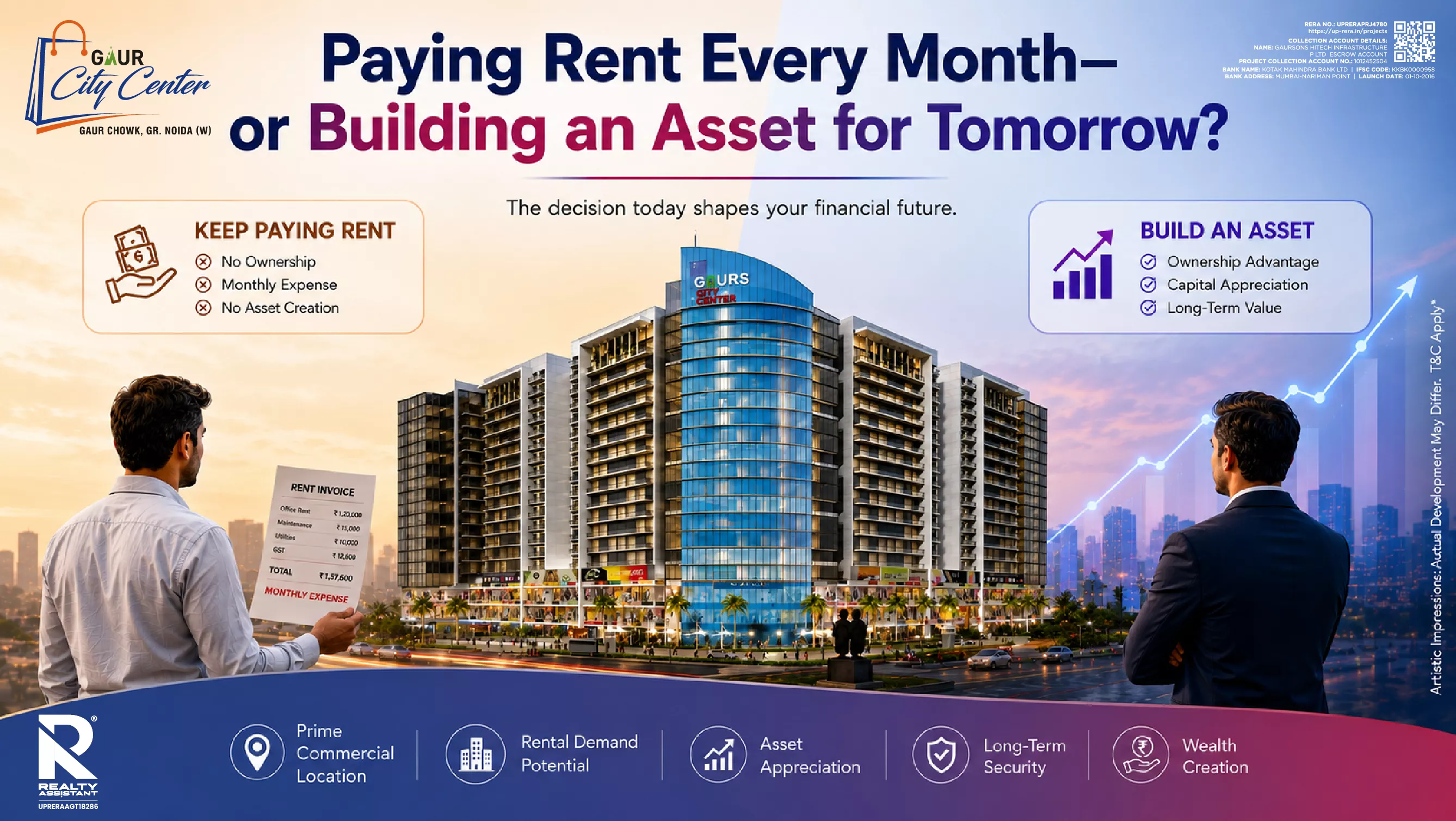
What if the money going toward rent could be building an asset instead?
The answer isn't always straightforward.
For some businesses, renting remains the smarter choice. For others, ownership can improve long-term financial stability while creating an appreciating commercial asset.
If you're evaluating workspace costs, expanding your business, or exploring an Office Space Investment, understanding the financial trade-offs is essential before making a decision.
Why This Question Matters More Than Ever
Commercial real estate has changed significantly over the last few years.
Earlier, office ownership often required a large capital commitment that was beyond the reach of small businesses and first-time investors.
Today, the availability of budget-friendly office property and competitively priced office inventory has made ownership accessible to a wider audience.
This shift is one reason many NCR businesses are actively comparing renting versus buying before renewing long-term lease agreements.
Renting vs Owning Office Space: A Financial Comparison
Businesses evaluating renting vs owning office space often compare more than monthly costs. The decision typically involves long-term occupancy plans, capital allocation, operational flexibility, and asset creation potential.
While renting may offer lower upfront commitments, ownership can provide long-term value through asset accumulation and greater cost predictability. The right choice depends on how a business plans to operate and grow over time.
Renting Office Space: The Advantages
Renting provides flexibility.
Businesses that are growing rapidly or still experimenting with different markets often prefer leasing because it requires lower upfront investment.
Benefits of Renting
- Lower initial capital requirement
- Easier relocation if business needs change
- No long-term ownership commitment
- Reduced maintenance responsibility
For startups and businesses with uncertain space requirements, these benefits can be valuable.
However, flexibility comes at a cost.
Monthly rent increases, lease renewals, and lack of asset creation can impact long-term financial efficiency.
To understand the financial implications more clearly, consider the following comparison between renting and owning office space:
Factor | Renting Office Space | Owning Office Space |
Upfront Cost | Lower | Higher |
Flexibility | High | Moderate |
Asset Creation | No | Yes |
Long-Term Stability | Lower | Higher |
Rental Escalation Risk | Present | Reduced |
Equity Building | No | Yes |
The Hidden Cost of Staying on Rent
While renting provides flexibility, long-term occupancy can create a recurring expense without contributing to asset ownership.
Imagine a business paying rent for five years.
At the end of that period:
- The landlord still owns the property
- Rental payments cannot be recovered
- Future rent continues to increase
The business gains operational utility, but no ownership value.
This is one reason many SMEs eventually begin exploring office ownership opportunities and evaluating available office space in Greater Noida West rather than remaining long-term tenants.
Owning Office Space: Looking Beyond Monthly Costs
Ownership shifts the conversation from expense to asset creation.
Instead of paying rent indefinitely, businesses build equity in a physical commercial property.
This creates potential advantages such as:
Long-Term Asset Building
The property becomes part of the company's balance sheet.
Greater Cost Predictability
Ownership can reduce exposure to recurring rental escalations.
Business Stability
Companies often benefit from operating out of a permanent location rather than renegotiating leases every few years.
Appreciation Potential
If the location develops positively, the asset may gain value over time.
These factors explain why Office Space Investment is increasingly being considered by business owners, not just traditional investors.
Many buyers now evaluate office ownership not only as an operational requirement but also as a long-term commercial asset that may support future business expansion and capital appreciation.
When Does Ownership Make More Financial Sense?
For many businesses, the decision ultimately depends on occupancy duration, financial capacity, and long-term growth plans.
Ownership is not automatically better.
However, it often becomes attractive when:
- The business plans to stay in the same location for 5+ years
- Rental expenses are rising consistently
- Affordable commercial ownership options are available
- The location demonstrates long-term growth potential
This is particularly relevant in emerging commercial markets such as Greater Noida West, where businesses are finding opportunities that were difficult to access a few years ago.
Why Greater Noida West Is Part of This Conversation
As commercial activity expands alongside residential growth, business owners are increasingly evaluating office ownership opportunities within emerging NCR markets.
This evolution has encouraged many businesses to compare the long-term cost of renting against the potential benefits of office ownership.
Commercial demand generally follows residential growth.
Greater Noida West has evolved from a primarily residential destination into a growing commercial ecosystem supported by a large population base.
As businesses establish themselves in the region, demand for:
- Business-ready office spaces
- Move-in-ready office units
- Commercial workspace in NCR
- Office units in Greater Noida West
has steadily increased.
Many buyers researching office property in Noida Extension are now evaluating ownership opportunities rather than continuing as tenants.
You can explore broader market opportunities through our guide to affordable office space in Greater Noida West, which examines why investor interest continues to grow in the region.
The Role of Entry-Level Office Investments
One reason ownership is becoming more realistic is the emergence of low entry office investment opportunities.
Instead of requiring a large commercial investment, buyers can now evaluate smaller office units that align with business requirements and investment budgets.
This trend is evident in several commercial hubs where office investment options are available at pricing levels that encourage first-time participation.
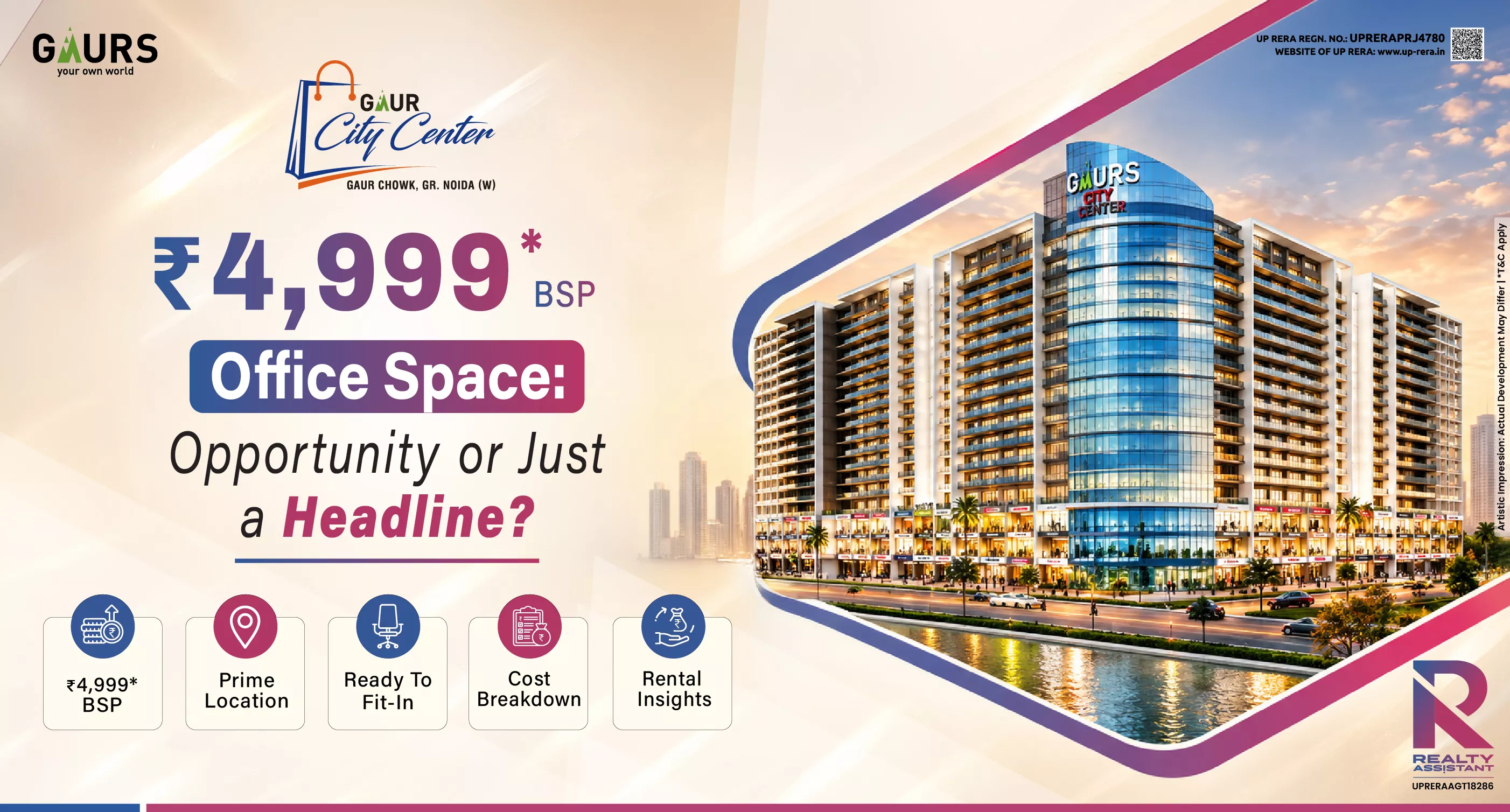
Our analysis on office space at ₹4,999 PSF explains how affordability is reshaping the commercial office market and influencing buyer behaviour.
How Investors Evaluate Commercial Office Inventory
Experienced investors rarely focus on pricing alone.
They typically assess:
Location Strength
Is the project located within a high-density residential catchment?
Occupier Demand
Will businesses actively lease or occupy the space?
Accessibility
Can employees, customers, and business partners reach the location easily?
Asset Quality
Are the units operational, functional, and suitable for professional use?
This is why buyers researching commercial office inventory often review operational projects rather than speculative opportunities.
For example, many investors evaluating office units in Greater Noida West eventually explore business-ready office spaces available within established commercial hubs.
One frequently researched option is the available office inventory at Gaur City Center, a commercial development located in Sector 4 near one of the region's most active residential catchments.
Rent or Buy? A Practical Decision Framework
Instead of asking:
"Which option is cheaper?"
Ask:
Rent If:
- You need maximum flexibility
- Your business is still evolving
- Capital availability is limited
Consider Ownership If:
- You expect long-term occupancy
- You want to build a commercial asset
- Rental expenses are becoming substantial
- Affordable office ownership opportunities are available
The right answer depends on your business objectives—not simply the monthly payment.
Final Thoughts
The debate around renting versus ownership isn't really about real estate.
It's about financial strategy.
For some businesses, renting remains the practical choice.
For others, an Office Space Investment can create long-term value while providing operational stability and asset ownership.
As Greater Noida West continues to attract businesses and investors, many buyers are increasingly evaluating office ownership opportunities, reviewing commercial office inventory, and comparing office investment options before renewing another long-term lease.
If you're currently comparing rent payments against ownership costs, reviewing available office inventory and understanding the numbers could provide a clearer picture of what makes financial sense for your specific situation.