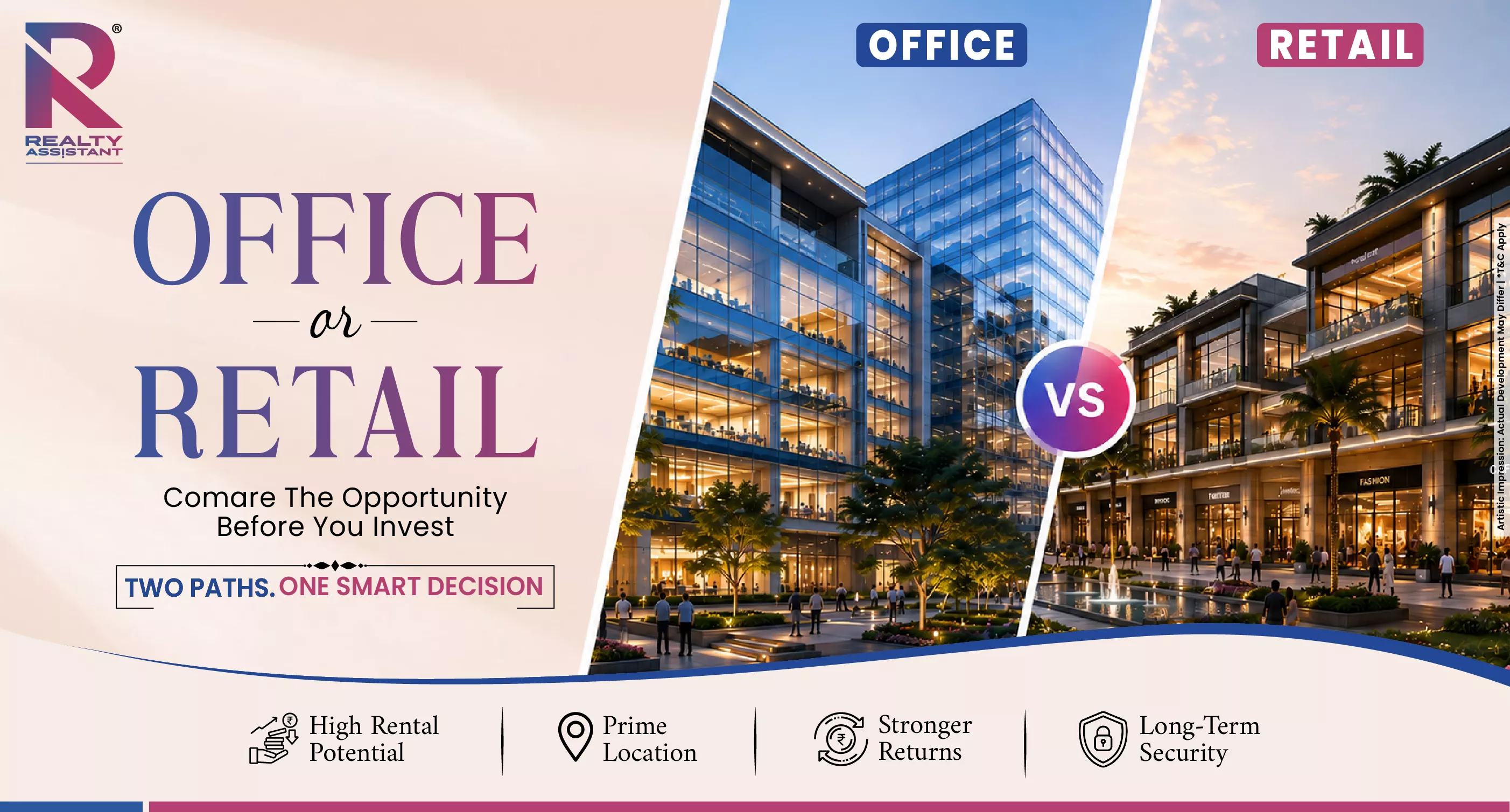
Choosing between office space vs retail shop investment depends less on the property label and more on how the asset is expected to perform.
An office may depend more on business accessibility, tenant demand and workplace requirements, while a retail shop can be more sensitive to visibility, frontage, footfall and consumer catchment.
So, which is better for investment: office space or retail shop?
There is no universal answer. The better option depends on your budget, location, intended use, tenant profile, vacancy risk, acquisition cost and investment horizon.
For buyers comparing commercial property in Greater Noida West, the decision becomes particularly relevant because residential catchments and commercial destinations are developing alongside each other.
This guide compares office space vs retail shop investment across rental potential, tenant demand, visibility, accessibility, acquisition cost, vacancy risk and long-term suitability.
Office Space vs Retail Shop Investment: Key Differences
At a basic level, both are commercial assets, but their demand drivers can be quite different.
Factor | Office Space | Retail Shop |
Primary demand | Business and professional activity | Consumer and business activity |
Main demand driver | Accessibility and tenant suitability | Visibility, frontage and customer movement |
Typical users | Offices, consultants, agencies, service businesses | Retail, F&B, salons, clinics and consumer services |
Location priority | Connectivity and workplace accessibility | Frontage, visibility and pedestrian/customer access |
Walk-in dependency | Usually lower | Usually higher |
Fit-out | Often required for workplace use | Depends on business category |
Vacancy consideration | Tenant demand and business suitability | Tenant demand, visibility and business viability |
Key investment checks | Tenant profile, occupancy, lease terms | Frontage, footfall, visibility, tenant mix |
Better suited to | Business use and leasing | Retail/business use and consumer-facing demand |
The key point is that office and retail properties should not be evaluated using exactly the same criteria.
A well-located office does not necessarily need the same characteristics as a successful retail unit.
Office Space Investment — Who Is It Suitable For?
Office space can suit investors who want exposure to commercial real estate while retaining the option of using the property for their own business.
Its investment potential generally depends on business accessibility, tenant demand, unit efficiency, building quality, vacancy risk and the overall commercial ecosystem rather than the headline rental figure alone.
It can potentially suit:
- Professionals planning their own workplace
- SMEs and service businesses
- Investors evaluating commercial rental demand
- Buyers looking for relatively compact commercial units
- Businesses that value accessibility and professional surroundings
For an investor, the important question is not simply "What is the rent?"
Instead, look at who would realistically occupy the unit.
For example, an office located close to residential catchment may benefit from businesses serving that population, but the actual tenant demand will depend on the building, accessibility, unit size, surrounding commercial ecosystem and competing supply.
If office property is your preferred category, you can compare available office spaces for sale in Greater Noida West based on location, size and intended use.
What Should Office Investors Check?
Before purchasing, examine:
- Unit efficiency and usable area
- Accessibility for employees and visitors
- Lift and common-area infrastructure
- Nearby commercial activity
- Existing office occupancy, where applicable
- Lease terms if purchasing an already leased unit
- Total ownership and maintenance costs
An office that looks inexpensive on a per-square-foot basis may not necessarily be the better investment if tenant demand is weak.
Retail Shop Investment — Who Is It Suitable For?
Retail property works differently from office space.
For a shop, visibility, frontage, accessibility and customer movement can have a direct relationship with business viability. A unit positioned where customers can easily see and reach it may have a very different commercial proposition from a similar-sized unit located deeper inside a development.
Retail shops can be considered by:
- Investors evaluating rental opportunities
- Buyers prioritising visibility and consumer catchment
When evaluating retail shop investment, consider the actual movement of people rather than assuming that a large residential population automatically means strong retail demand.
Look at:
- Nearby residential catchment
- Type of businesses operating nearby
For buyers specifically evaluating the local market, you can also explore shops for sale in Greater Noida West and compare available options according to business and investment requirements.
Office Space vs Retail Shop: Which Offers Better Rental Potential?
This is usually where investors want a simple answer.
But rental potential is not determined by property type alone.
A retail shop may command strong tenant interest in one location, while an office unit may perform better in another. Even within the same development, two units can have very different prospects because of floor, frontage, access, size and surrounding activity.
When comparing office vs retail rental income, examine these factors.
1. Location
For offices, accessibility to residential catchments, major roads and business areas can matter.
For retail, the exact position within the commercial development can be even more important.
2. Tenant Profile
Ask who is likely to rent the property.
An office may target consultants, agencies, professionals, technology businesses or other service companies.
A retail unit may attract F&B, fashion, convenience retail, salons, clinics or other consumer-facing businesses.
3. Footfall
Retail businesses often depend heavily on customer movement.
However, don't confuse projected footfall with proven commercial demand. If possible, assess actual activity and occupancy.
4. Visibility
A visible shop with good frontage can have a different business proposition from an internal unit.
For offices, visibility may matter less than accessibility, workplace environment and building quality.
5. Unit Size
Smaller units can sometimes appeal to a wider range of businesses, while larger units may attract a different tenant category.
The important thing is to match the unit with the likely demand.
6. Vacancy Risk
A higher quoted rent doesn't automatically mean a better investment.
If a property remains vacant for extended periods between tenants, the effective annual income can be considerably different from the headline rent.
7. Lease Terms
When comparing an occupied commercial property, examine:
- Maintenance responsibility
This gives you a much more realistic picture than looking at rent alone.
The more useful comparison is therefore the effective income after vacancy, maintenance and other ownership costs. A property with a slightly lower headline rent can sometimes be more attractive if tenant demand is stronger and vacancy periods are shorter.
Which Is Better for Long-Term Investment?
The right choice becomes clearer when you compare the two formats against your intended use, expected tenant profile, budget, location and holding period.
If Your Priority Is Business Use
An office space may make more sense if you need a professional workplace for your own business.
You are effectively combining property ownership with operational use.
If Your Priority Is Visibility
A retail shop may be more relevant when your business depends on customer walk-ins and visibility.
This is particularly important for consumer-facing businesses.
If Your Priority Is Rental Income
Compare actual rental demand rather than assuming one category always performs better.
Look at:
- Location within the project
If Your Priority Is Capital Appreciation
Look beyond the property itself.
Evaluate:
Capital appreciation should never be treated as guaranteed.
If You Want Lower Operational Complexity
Neither category is automatically easier.
A retail property may require greater attention to visibility and tenant suitability, while an office may require evaluation of workplace demand and tenant fit.
The right choice depends on the specific property.
Office Space vs Retail Shop Investment in Greater Noida West
Greater Noida West presents an interesting environment for commercial investors because residential development and commercial activity are closely connected.
A growing residential catchment can support demand for everyday retail, food and beverage, professional services, healthcare, education and other businesses. At the same time, office demand can emerge from businesses that want to operate closer to their customers and employee base.
This means investors should assess commercial property at three levels:
Micro-location → Commercial development → Individual unit
1. Micro-location → Is the surrounding catchment and connectivity suitable?
2. Commercial development → Does the project have the right design, accessibility, tenant mix and commercial environment?
3. Individual unit → Does the specific shop or office have the right floor, size, visibility, frontage, access and pricing?
A strong broader location cannot automatically compensate for a poorly positioned unit.
What Should Commercial Investors Evaluate in Greater Noida West?
Residential Catchment
Look at the existing and developing residential population around the commercial project.
The quality of the catchment matters as much as its size.
Accessibility
Consider how easily customers, employees and tenants can reach the property.
Road connectivity, entry points and parking can influence practical usability.
Commercial Ecosystem
A commercial project with complementary businesses can potentially create a stronger environment than an isolated unit.
For retail, a mix of businesses may also influence customer visits.
Supply and Competition
Check how many similar units are available nearby.
If there is substantial competing supply, your investment thesis should account for it.
This is often overlooked.
Two commercial developments within the same broader market can perform differently because of:
Office Space vs Retail Shop at Gaur City Center
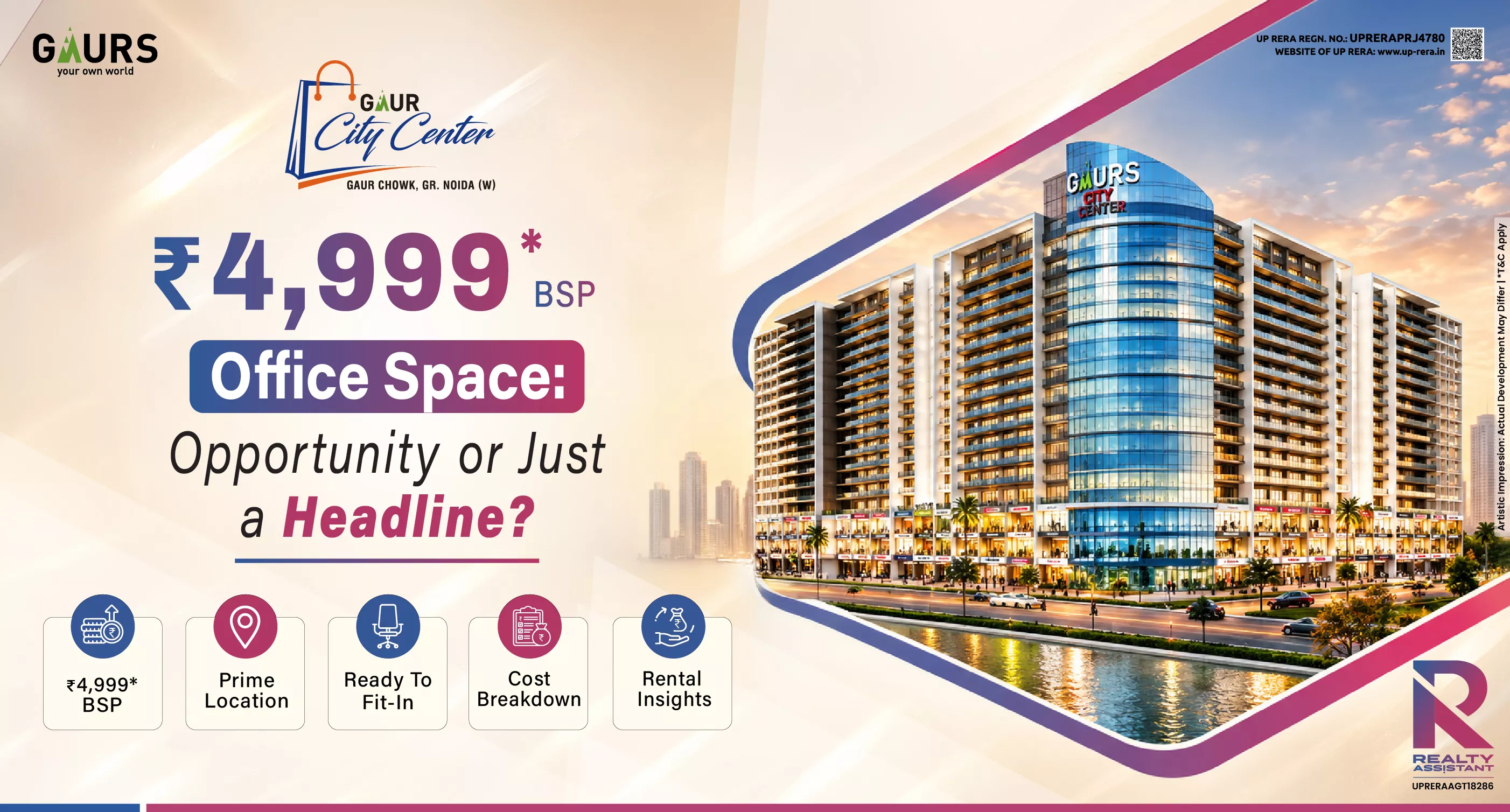
For investors comparing office space and retail shops in Greater Noida West, Gaur City Center provides a practical project-level example of how different commercial formats can be evaluated within the same development.
The project includes retail shops, office spaces and studio-oriented commercial options, giving buyers an opportunity to compare different commercial formats based on intended use, tenant profile, visibility, accessibility and investment objectives.
The important point is that the project name alone does not determine investment suitability. The specific unit, floor, size, position, access, visibility and acquisition cost can materially change the investment proposition.
What to Compare at Gaur City Center
For a broader project perspective, review the Gaur City Center investment guide and Gaur City Center ROI analysis.
If you are already comparing specific units, explore Gaur City Center project details for project-level information.
Office Space vs Retail Shop: A Practical Investor Comparison
If you are still undecided, use this framework:
Investor Priority | Office Space | Retail Shop |
Own business use | Strong fit for professional/service businesses | Strong fit for customer-facing businesses |
Walk-in customers |
Usually less important | Highly important |
Visibility | Important but generally secondary | Often critical |
Tenant demand | Business/service demand | Consumer/business demand |
Rental income | Depends on tenant demand and vacancy | Depends on location, visibility and tenant demand |
Capital appreciation | Depends on location and commercial ecosystem | Depends on location, frontage and demand |
Operational suitability | Professional/service businesses | Retail, F&B and consumer-facing businesses |
What to evaluate | Accessibility and tenant profile | Frontage, visibility and footfall |
Both office and retail properties can perform differently depending on location, demand, unit characteristics, acquisition cost and the surrounding commercial ecosystem. The individual asset, location and purchase price can matter more than whether the property is labelled "office" or "retail."
How to Calculate the Investment Before Buying
Don't stop at the quoted property price or advertised rent.
Create a simple investment worksheet that considers the total acquisition cost, realistic rental income, vacancy and recurring expenses.
Step 1: Calculate Total Acquisition Cost
Include:
- Registration and statutory costs
- Initial maintenance or other charges
Step 2: Estimate Realistic Rental Income
Use comparable properties in the same micro-market rather than relying only on advertised rents.
Step 3: Account for Vacancy
Build a reasonable vacancy assumption into your calculation.
Step 4: Deduct Recurring Costs
Consider:
Step 5: Compare Gross and Net Rental Yield
A simple starting point is:
Gross rental yield = Annual rent ÷ Total acquisition cost × 100
For a more realistic view, calculate net income after vacancy and recurring ownership costs.
Net rental yield = Net annual rental income ÷ Total investment cost × 100
For example, two properties with similar advertised rents can produce different net yields if one has higher vacancy, maintenance costs or acquisition expenses.
The resulting figures should be compared with similar properties in the same micro-market rather than treated as guaranteed returns.
Also compare the alternative use of your capital.
Step 6: Consider Exit Liquidity
Before investing, consider how easily the property could be sold in the future.
Look at:
- Comparable resale activity
- Unit size and positioning
- Location and accessibility
A property can have attractive rental potential but still be less suitable if the eventual resale market is limited.
What Should You Check Before Buying a Commercial Property?
Before paying a token amount or signing an agreement, review the project and unit carefully.
Property-Level Checks
Project-Level Checks
- RERA information where applicable
- Approvals and documentation
For developer context, you can also review the Gaurs Group developer profile, while keeping the final evaluation focused on the specific commercial project and unit.
Financial Checks
A property should make sense on its own numbers rather than because of a general market narrative.
Office Space vs Retail Shop: Which Property Fits Your Investment Objective?
The stronger option depends on the combination of location, tenant demand, business suitability, entry cost and your investment objective.
Retail shops can make more sense for buyers prioritising visibility, customer movement and businesses that depend on regular walk-in traffic.
Office spaces may be more suitable for buyers focused on professional tenants, business use and longer-term leasing potential.
Before choosing between the two, compare the property's location, catchment, accessibility, tenant demand, total acquisition cost, expected occupancy and resale potential. The objective should be to select the asset that matches your investment strategy—not simply the property type that appears to offer the higher return.
A Simple Decision Checklist
Before making your decision, ask yourself these seven questions:
- Will I use the property myself or lease it?
- Who is the most likely tenant or customer?
- Does the location support that business profile?
- Is the unit visible and accessible enough for its intended use?
- What are comparable rents in the immediate area?
- What happens if the property remains vacant for several months?
- Does the total investment make sense after all costs?
If you can answer these questions with actual data, the office space vs retail shop investment decision becomes much less subjective.
Looking for the Right Commercial Investment in Greater Noida West?
Ultimately, the decision should come down to how the property is expected to be used and what you want it to achieve. A retail unit may make more sense when visibility, customer access and frontage are critical, while an office may be more suitable when workspace functionality, professional tenant demand and business use are the priority.
The better question isn't simply “office or retail?” It is: Which property fits your budget, intended use, tenant profile and investment objective?
If you're comparing commercial opportunities in Greater Noida West, explore:
Need help comparing commercial properties? Share your preferred property type (office space or retail shop), approximate budget, preferred location and intended use. We can help you compare relevant options based on unit size, location, current availability and project details.
The goal is to compare the property, location, numbers and intended use together before making an investment decision.