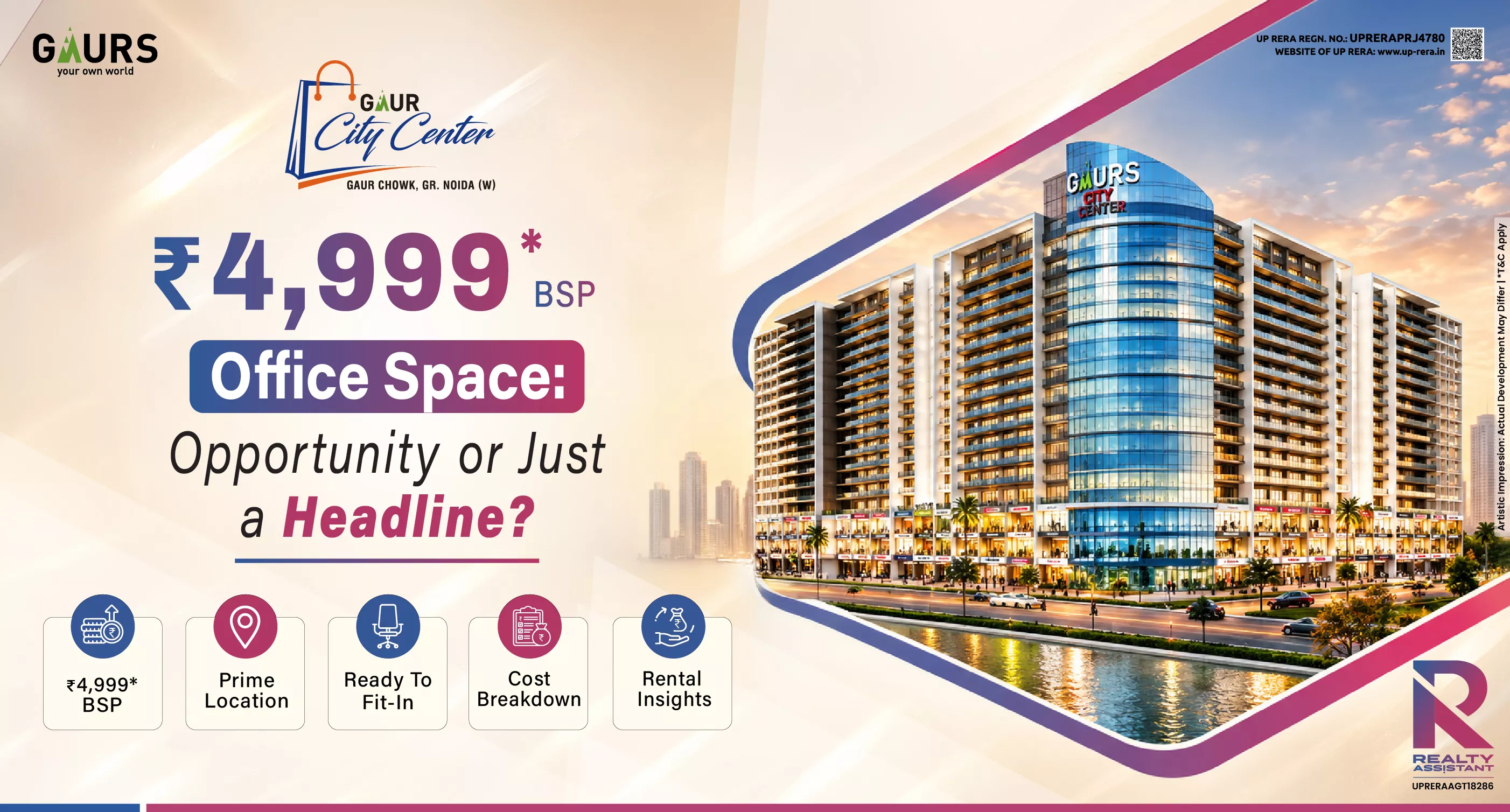
Buying commercial property can look simple when the advertised price and expected rent appear attractive. The difficult part is identifying what the headline numbers don't show.
A low purchase price may come with higher fit-out or maintenance costs. A promising location may have plenty of competing supply. And a projected rental return means little if finding a tenant takes longer than expected.
For first-time investors, the safest approach is to evaluate the property, location, documents, costs, tenant demand and exit potential together.
This guide covers the most common mistakes buyers should avoid before investing in commercial real estate, with practical checks you can use while evaluating opportunities in Greater Noida West.
Why Commercial Property Requires More Due Diligence
Residential buyers often focus on lifestyle, configuration and location.
Commercial investors need to think differently.
The property is also a potential business asset. Its performance can depend on customer movement, tenant demand, accessibility, visibility, operating costs, lease terms and the wider commercial ecosystem.
That's why the question shouldn't simply be:
"Is this property a good deal?"
Instead, ask:
"Does this property make sense at this price, for this location, for this type of tenant or business?"
10 Common Commercial Property Investment Mistakes
1. Buying Based Only on the Advertised Price
A quoted price is only the starting point.
Your actual acquisition cost may include:
- Registration and statutory charges
- Maintenance or other project charges
- Brokerage, where applicable
- Other transaction-related expenses
A property advertised at an attractive rate may have a very different total investment requirement after these costs are included.
Better approach: Calculate the complete acquisition cost before comparing two properties.
2. Ignoring Location-Level Demand
A commercial project can be in a growing city but still have limited demand at its specific location.
Look beyond the project brochure and examine:
- Competing commercial developments
For a retail unit, visibility and customer movement can be particularly important.
For an office, accessibility for employees and clients may matter more.
If you are evaluating the wider market first, the commercial property guide can help you understand these location and investment factors in greater detail.
3. Assuming Rental Returns Are Guaranteed
One of the biggest commercial property investment mistakes is treating an advertised or projected rental return as certain income.
Actual rental performance can depend on:
A property generating a particular rent today does not mean the same rental income will continue indefinitely.
Better approach: Build your calculation around realistic rent and include a vacancy assumption.
4. Focusing on Purchase Price Instead of Total Investment Cost
The purchase price tells you what you may need to pay to acquire the property. It does not tell you what the investment will cost to own and operate.
A commercial property can require additional capital for fit-out, financing, maintenance, repairs, property management and other recurring expenses.
Calculate:
Total investment = Purchase cost + acquisition charges + fit-out + financing + other applicable costs
Then consider recurring expenses such as:
This gives you a more realistic basis for comparing potential returns.
5. Skipping Legal and Regulatory Verification
Before committing money, verify the project and transaction documentation relevant to the property.
Depending on the project and transaction, this may include:
- RERA registration and applicable disclosures
- Title and ownership documentation
- Current construction status
Don't rely solely on a salesperson's explanation.
Better approach: Review the relevant documents and take professional legal advice where necessary.
6. Ignoring Unit-Level Visibility and Accessibility
Two units in the same project can have very different commercial potential.
Check the actual unit for:
- Loading/unloading requirements, where relevant
This is particularly important for retail.
For office space, consider how easily employees, clients and visitors can reach the unit.
Never evaluate only the project. Evaluate the exact unit.
7. Choosing the Wrong Commercial Property Type
An investor may buy an office because the entry price looks attractive, even though their intended strategy requires customer visibility.
Another buyer may purchase a retail unit when their actual objective is to create a professional workplace.
Before choosing between an office and shop, define your objective.
For investors, the property type should also be judged by the tenant profile, leasing demand and exit audience it can realistically attract.
Office may be more relevant for:
Retail may be more relevant for:
- Visibility-driven businesses
For a detailed comparison, see office space vs retail shop investment.
8. Not Researching Tenant Demand
A commercial property becomes an income-generating asset only when there is sustainable demand for its use.
Ask:
Who would realistically rent this unit?
Then investigate:
Don't assume that a large residential population automatically guarantees commercial occupancy.
The quality and spending profile of the catchment, accessibility and competition all matter.
9. Ignoring Maintenance and Operating Costs
Rental income isn't the same as net income.
An investor should understand who pays for:
A property with a slightly lower rent but lower recurring expenses may sometimes produce a more efficient net return than a property with a higher headline rent.
Always compare net income, not just gross rent.
A commercial property with higher advertised rent is not automatically the better investment.
Consider the income left after realistic vacancy and recurring ownership expenses.
Net annual income = Gross annual rent − Vacancy allowance − Recurring property expenses
Comparing net income gives you a more realistic picture of the property's potential performance.
10. Not Having an Exit Strategy
Buying is only one part of the investment decision.
Before investing, ask:
- Who could buy this property from me later?
- Is there an active resale market?
- Would an end-user consider the unit?
- Is the location attracting businesses?
- Is there competing inventory?
- How easy would it be to lease or resell?
A property with multiple potential buyer profiles may offer more flexibility than one dependent on a very narrow tenant or business category.
Your investment horizon matters too.
How to Avoid Commercial Property Investment Mistakes Before Buying
A practical evaluation can be divided into five areas:
- Property: Check size, floor, frontage, access, visibility and permitted use.
- Location: Study catchment, connectivity, competition, footfall and surrounding development.
- Financials: Calculate total acquisition cost, financing, maintenance, realistic rent and vacancy.
- Documentation: Verify RERA applicability, approvals, ownership/title documentation and agreement terms.
- Exit: Understand the potential resale and leasing audience before you buy.
This approach turns a vague investment decision into a structured evaluation.
Office or Retail: Which Fits Your Investment Goal?
The right commercial format depends on what you want from the asset.
If you need a workplace for your own business, office space may be more practical.
If your business depends on walk-in customers, retail may deserve greater attention.
If rental income is your priority, compare actual tenant demand and lease economics for specific units.
And if you're primarily looking for capital appreciation, assess the location, development pipeline, demand and competing supply rather than relying on projected returns.
Evaluating Commercial Property in Greater Noida West
Greater Noida West has an expanding residential catchment alongside an evolving commercial ecosystem.
For investors, this makes the micro-location particularly important.
Don't stop at the broader Greater Noida West label.
Evaluate:
- Which residential communities are nearby?
- What commercial developments already operate?
- Where is customer movement concentrated?
- How accessible is the project?
- What competing supply is coming?
- Which businesses are already operating successfully?
This helps distinguish between market growth and property-level investment potential.
Example: Evaluating Gaur City Center
Once you understand these common mistakes, the same framework can be applied to an individual commercial development.
For example, buyers considering commercial opportunities in Greater Noida West can use these checks to evaluate a project such as Gaur City Center.
The important point is not to conclude that a project is suitable simply because it is in a recognised commercial location.
Instead, examine the specific available unit and its numbers.
Consider:
If you are specifically comparing office space and retail shops within a commercial development, our office space vs retail shop investment guide provides a broader comparison of tenant demand, visibility, vacancy risk and investment suitability.
Commercial Property Investment Checklist
Before making a purchase decision, use this quick checklist:
Check | What to Verify |
Price | Total acquisition cost |
Unit | Floor, size, frontage, access |
Location | Catchment, connectivity, competition |
Demand | Tenant and business demand |
Rent | Comparable market rents |
Vacancy | Realistic vacancy assumption |
Costs | Maintenance, fit-out, financing |
Legal | RERA, approvals, title/documents |
Project | Construction/possession status |
Exit | Resale and leasing audience |
If several answers remain unclear, the investment deserves more investigation before you commit.
Planning to Invest in Commercial Property?
Avoiding mistakes starts with comparing the property, location and numbers together.
A commercial property should not be judged by its advertised price, projected rent or project reputation alone. The actual unit, total investment cost, tenant demand, documentation and exit potential all need to make sense for your strategy.
If you're still researching the market, start with the commercial property guide to understand the broader investment factors.
If you're ready to evaluate a specific opportunity, you can explore Gaur City Center property details and assess its available commercial inventory against your investment objective.
The goal isn't to find the property with the lowest price. It's to find the property whose numbers, location and demand make sense for your strategy.